|
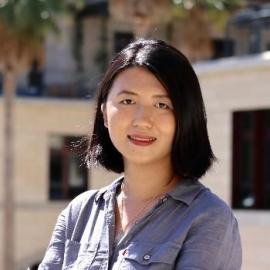
Assistant Professor Address: 581 PAIS Building, 36 Eagle Row, Atlanta, 30322 |
I am an Assistant Professor in the Department of Data and Decision Sciences at Emory University, where I have been on the faculty since Fall 2021. Before joining Emory, I was a postdoctoral researcher at the Stanford Graduate School of Business. I received my Ph.D. in Management Science and Engineering from Stanford University and my B.S. degrees from Peking University. My research lies at the intersection of econometrics, operations research, and machine learning.
Research Overview
I develop quantitative methods for panel data, causal inference, and experimental design, motivated by decision problems in digital platforms, healthcare, and finance. My research has three connected themes.
Statistical inference methods for large-dimensional panel data. I develop latent factor methods that uncover patterns shared across units and time in high-dimensional panels, with an emphasis on inference, missing data, and interpretable structure. This work provides entry-wise inferential theory, with applications in causal inference and asset pricing. Topics include endogenously missing observations (JoE’23; Management Science, accepted), transfer learning across panels (JoE’24), state-varying dynamics (JBES’22), and sparse interpretable factors (JBES’22).
Causal machine learning. I develop causal machine learning methods for complex real-world settings. In healthcare, I study representation learning for multimodal clinical data with informative missingness across static modalities (EMNLP’25) and clinical time series (Findings of ACL’26). I also develop privacy-preserving federated causal inference methods for combining evidence across medical databases (Statistics in Medicine’23); methods for treatment effect estimation under network interference using semiparametric statistics (JBES, accepted) and causal message passing (NeurIPS’24; working paper); and stable prediction methods for unknown environments (KDD’18) and model misspecification (AAAI’20).
Design and analysis of time-series experiments. I study how to design and analyze experiments that unfold over time, where treatment effects may persist and treatment timing is a central design choice. This work develops methods for choosing who should receive treatment and when, with the goal of reducing bias and improving statistical efficiency in applications such as digital platforms and public health. Topics include staggered rollout designs (Management Science’24; working paper), switchback designs (working paper), and automated design using historical-data simulations and gradient-free optimization (working paper).
Working Papers
Data-Driven Switchback Experiments: Theoretical Tradeoffs and Empirical Bayes Designs [slides]
R. Xiong, A. Chin, S. J. Taylor
Semiparametrically Efficient Stepped Wedge Designs
H. Wang, R. Xiong
Can We Validate Counterfactual Estimations in the Presence of General Network Interference?
S. Shirani, Y. Luo, W. Overman, R. Xiong, M. Bayati
Partial Identification under Missing Data Using Weak Shadow Variables from Pretrained Models
H. Chen, D. Simchi-Levi, R. Xiong
Journal Publications
Factor Analysis for Large Non-Stationary Panels with Endogenous Missingness and Applications to Causal Inference [slides]
J. Duan*, M. Pelger*, R. Xiong*
Management Science, accepted
Semiparametric Estimation of Treatment Effects in Observational Studies with Heterogeneous Partial Interference [slides] [talk] [code]
Z. Qu*, R. Xiong*, J. Liu*, G. Imbens
Journal of Business & Economic Statistics, accepted
Optimal Experimental Design for Staggered Rollouts [slides] [code]
R. Xiong, S. Athey, M. Bayati, G. Imbens
Management Science, 2024, 70(8), 5317-5336
2020 MSOM Student Paper Competition Finalist
Target PCA: Transfer Learning Large Dimensional Panel Data [slides]
Internet Appendix
J. Duan*, M. Pelger*, R. Xiong*
Journal of Econometrics, 2024, 244(2), 105521
Federated Causal Inference in Heterogeneous Observational Data [slides] [code] [lay abstract]
R. Xiong, A. Koenecke, M. Powell, Z. Shen, J. T. Vogelstein, S. Athey
Statistics in Medicine, 2023, 1–22, doi: 10.1002/sim.9868
Large Dimensional Latent Factor Modeling with Missing Observations and Applications to Causal Inference [slides]
Internet Appendix
R. Xiong, M. Pelger
Journal of Econometrics, 2023, 233(1), 271-301
2019 George Nicholson Student Paper Competition Honorable Mention
Interpretable Sparse Proximate Factors for Large Dimensions [slides]
M. Pelger*, R. Xiong*
Journal of Business & Economic Statistics, 2022, 40(4), 1642-1664
State-Varying Factor Models of Large Dimensions [slides]
Internet Appendix
M. Pelger*, R. Xiong*
Journal of Business & Economic Statistics, 2022, 40(3), 1315-1333
Refereed Conference Proceedings
Learning Dynamic Representations and Policies from Multimodal Clinical Time-Series with Informative Missingness
Z. Liang, Z. Pan, R. Xiong
Findings of ACL 2026
Causal Representation Learning from Multimodal Clinical Records under Non-Random Modality Missingness
Z. Liang, Z. Pan, R. Xiong
EMNLP 2025
Higher-Order Causal Message Passing for Experimentation Under Unknown Interference
M. Bayati*, Y. Luo*, W. Overman*, S. Shirani*, R. Xiong*
NeurIPS 2024
Two-Stage Shadow Inclusion Estimation: An IV Approach for Causal Inference under Latent Confounding and Collider Bias
B. Li, A. Wu, R. Xiong, K. Kuang
ICML 2024
Learning Shadow Variable Representation for Treatment Effect Estimation under Collider Bias
B. Li, H. Li, R. Xiong, A. Wu, F. Wu, K. Kuang
ICML 2024
Stable Estimation of Heterogeneous Treatment Effects
A. Wu, K. Kuang, R. Xiong, B. Li, F. Wu
ICML 2023
Stable Prediction with Model Misspecification and Agnostic Distribution Shift
K. Kuang, R. Xiong, P. Cui, S. Athey, B. Li
AAAI 2020
Stable Predictions across Unknown Environments
K. Kuang, P. Cui, S. Athey, R. Xiong, B. Li
KDD 2018 (oral)
Idle Manuscripts
Deep Learning Stock Volatility with Google Domestic Trends
R. Xiong, E. Nichols, Y. Shen
Courses
DATASCI 347, Machine Learning: Fall 2023, Spring 2024, Fall 2024, Spring 2025, Spring 2026, Fall 2026
DATASCI 385, Quantitative Finance: Fall 2022, Spring 2023, Fall 2023, Fall 2024, Fall 2026
DATASCI 385, Machine Learning and Causal Inference: Fall 2021, Spring 2022, Fall 2022
Student Mentoring at Emory
Undergraduate Honors Thesis Advisees:
Phoebe Pan (2026, co-first author of EMNLP’25 and Findings of ACL’26 papers, incoming PhD at Yale)
Zihan Liang (2026, co-first author of EMNLP’25 and Findings of ACL’26 papers, incoming PhD at Duke)
Tsebaot Shewarega (2025, researcher at MIT)
Krystal Song (2024, Evercore)
Hao Wang (2023, first author of a submitted paper on experimental design, PhD at Yale)
Leah Gao (2022, Paylocity)
Undergraduate Honors Thesis Committee Members:
Haoyang Cui (2024, MS at MIT), Tia Hu (2024, Citi), Zoe Ji (2024, PhD at Stanford), Judy Hao (2023, PhD at UT Austin), Echo Sui (2023, MS at Stanford), Yixiao Chen (2023, MS at Yale), Zhou Fang (2022, MS at Harvard), Katherine Wang (2022, MS at MIT), Ethan Feldman (2022, UJA-Federation of New York)
Undergraduate Researchers:
Kevin Lee (2023, JD at Harvard), Francis Lin (2022, JD at Georgetown)
2021: Postdoc, Graduate School of Business, Stanford University
2020: Ph.D., Department of Management Science and Engineering, Stanford University
2014: B.S., Peking University